
Is BPC 157 Legal Now?
What the October 2026 rules mean for patients in Gilbert and Mesa

You want to heal. You want less pain. And you want to know if a treatment is worth trying.
If you have heard about BPC-157, you may also have heard that it is now legal. The answer needs a little more care.
The short answer:
The new policy opens a limited path for doctors and pharmacies to make BPC-157 for patients. Strict rules apply. BPC-157 is still not FDA-approved, and strong proof of its benefits and long-term safety is lacking.
What is BPC 157
BPC-157 is a peptide. That means it is a short chain of amino acids, the building blocks of protein.
People often ask about it for joint pain, injuries, or gut problems. Animal studies have raised interest in its role in healing. But a result in a rat does not tell us what will happen in a person.
What changed in October 2026
On October 30, 2026, the U.S. Department of Health and Human Services, or HHS, published notice of a new policy.
Under this policy, HHS says it does not plan to take action against certain pharmacies and doctors that make listed peptides, if they meet all the rules. BPC-157 is one of those peptides.
This is called enforcement discretion. It changes how the agency plans to enforce the law. It does not change the law itself.
The policy is temporary. It may change as the FDA reviews these drugs and writes final rules. State rules still apply, too.
Does that mean BPC 157 is FDA approved
No. The new policy does not give BPC-157 FDA approval.
A compounded drug is made by a pharmacy or doctor for a patient’s needs. The FDA does not check each compounded drug for safety, quality, or how well it works before it is sold.
Keep this distinction in mind:
A prescription does not mean a drug is FDA-approved. The new policy changes access. It does not prove that BPC-157 is safe or works.
The 10 rules in plain language
The policy has 10 conditions. This is a short guide, not the full legal checklist.
| Policy rule | What it means for you |
|---|---|
| 1 Listed peptide | The peptide must be on the policy’s list. |
| 2 Right form | BPC-157 must be the acetate form, given in a listed way. |
| 3 Batch tests | Each batch of the raw ingredient needs tests for identity, strength, purity, and harmful substances. |
| 4 Verified maker | The original maker must be FDA-registered and meet drug-making standards. Its location must be on the test report. |
| 5 Required reports | The pharmacy or doctor must report required product details, serious side effects, and quality problems to the FDA and states. |
| 6 Clear label | The label must say it is a compounded drug and is not for resale. |
| 7 One active drug | Peptide blends do not qualify. |
| 8 Oral absorption | For an oral form, the pharmacy must keep proof that the body can absorb that exact formula. |
| 9 Delivery device | Any device packed with or holding the drug must be an FDA-cleared syringe. |
| 10 Other rules | Other federal rules still apply, including clean conditions and a prescription for a named patient. |
Which forms are listed:
For BPC-157, the policy lists shots under the skin or into muscle, oral forms, and skin products. IV drips, nasal sprays, and shots into a joint are not listed. All policy conditions still apply.
What does the research show
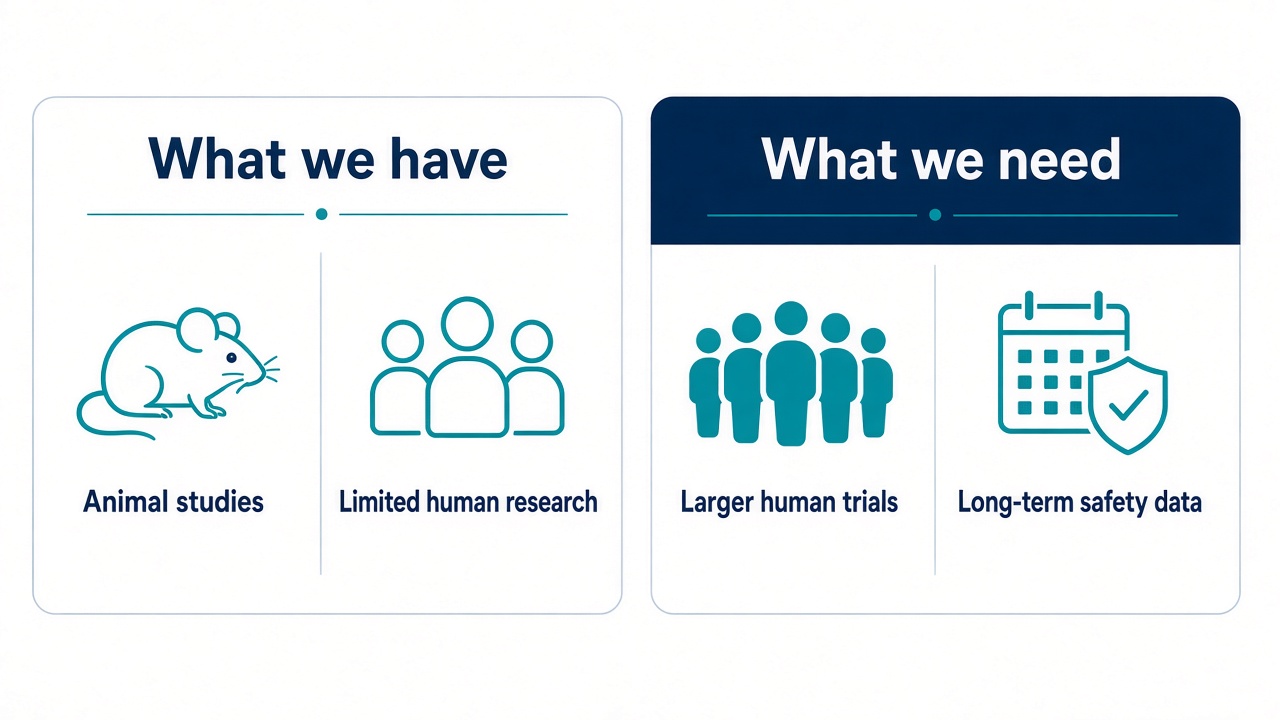
Most of the research people share comes from animal studies. Human research is still limited.
| Type of evidence | What it can tell us | What it cannot prove |
|---|---|---|
| Animal studies | Why researchers are interested in healing and tissue repair. | That the same effects happen in people. |
| Small human reports | What happened to a small group of patients. | That BPC-157 caused the change or is safe over time. |
| Early gut trial | A small trial compared BPC-157 enemas with a placebo, a treatment with no active drug. | Clear benefits, given the limited study details. It also cannot establish results from shots or pills. |
We still need larger, well-designed human studies to learn who might benefit, what dose to use, and what risks to expect.
What I have seen in practice
Before the FDA restrictions in 2023, I prescribed BPC-157 for several years. I saw many patients report less pain and better movement.
Those reports matter to me. They are part of why I take an interest in this treatment.
But they do not prove that BPC-157 caused the change. Some injuries heal with time. Physical therapy, other care, and a patient’s hopes can also affect results.
My role is to share both my experience and its limits. You deserve to know what we have seen and what research has yet to prove.
Is BPC 157 safe
We do not have enough data to say it is safe, especially with repeated or long-term use.
The FDA has raised concerns about immune reactions and problems with drug quality. An immune reaction happens when the body’s defense system reacts to a substance.
We also need better answers about drug interactions and use in people with kidney or liver disease.
A safety point worth remembering:
Few reported side effects in a small study do not rule out rare or long-term harm.
Who should avoid it
In my practice, I would avoid BPC-157 in children and in people who are pregnant, breastfeeding, or trying to get pregnant. We lack good safety data for these groups.
I would also avoid it in people with active or past cancer. Animal studies suggest it can affect the growth of blood vessels. That raises a concern worth taking seriously. It does not prove that BPC-157 causes cancer or makes it grow.
People with serious kidney or liver disease need special caution. Athletes who face drug testing should also know that BPC-157 is banned under World Anti-Doping Agency rules.
And if an injury has not been diagnosed, start there. A torn tendon may need a specialist. Ongoing pain may need tests. A peptide should not delay the right care.
Why the source matters
Do not assume that every vial labeled BPC-157 holds the same thing.
The new policy calls for testing and checks on the maker. Those steps help address concerns about what is in the product. They do not prove that the treatment works or remove every risk.
Products marked “research use only” are not covered as patient treatments under this policy.
Five questions to ask before you start
- Which pharmacy makes it? Is that pharmacy licensed to serve patients in Arizona?
- Can you explain the batch testing? What was checked, and who made the raw ingredient?
- Is this a single-ingredient product? Does it meet the policy’s rules?
- Why are you suggesting this for me? What other options have stronger evidence?
- What is the follow-up plan? How will we track progress, when will we stop, and whom do I call about side effects?
A red flag:
Be cautious about promises of guaranteed healing. A clear plan should include room to decide against treatment.

Our approach at Modern Body Clinic
For patients in Gilbert, Mesa, and nearby communities, our approach starts with a clear diagnosis and an honest talk.
We discuss your symptoms, health history, goals, and other treatment choices. Physical therapy, an approved drug, or a specialist may be the best next step.
If we consider BPC-157, we discuss the gaps in the research and the risks we cannot yet measure. We also need to confirm that the product and pharmacy meet current rules.
Any plan should have a clear goal, a way to track results, and a point to stop if it is not helping.
Start with a physician visit.
Tell us what hurts, what you have tried, and what you want to get back to doing. Contact Modern Body Clinic to discuss your options.
This article is for education and does not replace medical advice. BPC-157 and compounded BPC-157 products are not FDA-approved. Rules may change. Talk with a licensed physician before starting treatment.
Sources
- HHS peptide compounding policy and appendices
- Federal Register notice published October 30 2026
- FDA July 2026 review of BPC 157
- FDA guide to the risks of compounded drugs
- Published knee pain report on PubMed
- Arizona Board of Pharmacy permit verification
- WADA 2026 Prohibited List
Links checked November 14, 2026.