

Is Phentermine Safe With Semaglutide? Here’s How We Actually Decide
One of the most common questions Dr. Carter gets at Modern Body Clinic in Gilbert is whether phentermine and semaglutide can be used together. The short answer is yes, they can be. The more useful answer is that “can” and “should” are two different questions, and the second one depends entirely on the person sitting in front of the doctor.
In this post, we’re breaking down how that decision actually gets made in the clinic: what each medication does, what gets checked before combination therapy is even on the table, who should be cautious, and the five questions we think everyone should ask themselves before assuming another medication is the fix.
Why this question comes up at all
Patients rarely ask about combining these medications out of curiosity. Usually something has stalled. Weight loss has slowed down, a plateau has set in, appetite is creeping back, or “food noise,” that background hum of thinking about food, has returned. When progress stops, it’s natural to look for a bigger tool. Sometimes that’s the right call. Figuring out which situation you’re actually in is the point of an evaluation, not a five-minute guess.
More often, it’s not the patient who brings up combination therapy first. It’s the clinic, because something in a person’s history, response pattern, or phenotype points that direction before they’ve even asked.
What each medication actually does
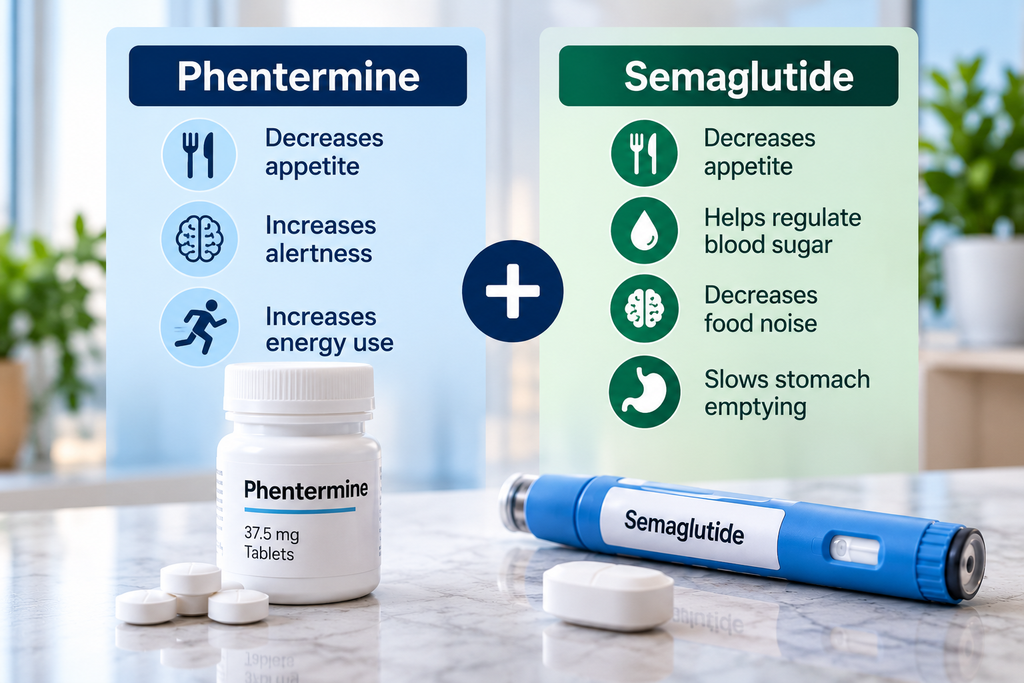
Phentermine and semaglutide work through completely different mechanisms, which is part of why combining them can make sense for the right person.
Phentermine is a stimulant. It decreases appetite, increases alertness, and increases energy use.
Semaglutide works through the GLP-1 pathway. It also decreases appetite, but it does more than that: it helps regulate blood sugar, decreases food noise, and delays how quickly food empties from the stomach, which is what makes you feel fuller for longer.
Because the two medications don’t operate on the same system, they don’t simply stack on top of each other. In the right patient, they complement each other. But that “right patient” qualifier matters more than it sounds like it should. We’ve written more on how these two medications compare directly in Semaglutide vs. Phentermine: Which One Is Right for You.
The biggest myth in medical weight loss
Here’s the belief that causes the most damage: more medication automatically means better or faster results. It doesn’t, and it’s not true for combination therapy either.
If sleep is poor, protein intake is low, you’re losing more muscle than you should be, or your daily routine has become inconsistent, adding phentermine to semaglutide will not fix the actual problem. The combination works best when the foundation, meaning sleep, protein, training, and consistency, is already in place. Skipping that step and reaching straight for a second medication is one of the most common mistakes patients (and some prescribers) make.
What we check before considering combination therapy

Before phentermine and semaglutide are combined, several things get evaluated:
Medical history and safety first. For phentermine specifically, that means screening for heart problems (stable or not), history of stroke, insomnia, anxiety, or sensitivity to stimulants. Safety gets checked before anything else.
Pattern response. Did semaglutide work at first and then stop, or did it never produce much movement in the first place? Those are two different clinical problems that call for two different responses.
Phenotype. Mayo Clinic research has identified distinct biological subtypes of obesity that respond differently to the same medication, based on factors like appetite-hormone levels, how quickly the stomach empties, and metabolic history. That’s the kind of pattern we’re screening for.
Muscle preservation. The goal isn’t just weight loss, it’s losing the right kind of weight. Part of the evaluation is asking whether adding a stimulant will help or hurt that goal.
Sustainability. Is the plan being built to hold up long term, or is it optimized for a short-term number on the scale?
Who should be more cautious
Even when combination therapy makes clinical sense in general, there are situations that call for real caution, or ruling phentermine out entirely:
- New or unstable heart problems, such as a recent heart attack or a history of heart failure
- Uncontrolled high blood pressure (controlled hypertension is not automatically a disqualifier)
- Sensitivity to stimulants
- Anxiety, which is a situational caution rather than an automatic no
- Medications that would interact with phentermine and can’t be adjusted
- Sleep disorders or insomnia
None of this is caution for its own sake. It’s about matching the tool to the person in front of you, and sometimes that means reaching for a different tool entirely.
What we look at before adding any medication

This is the part that doesn’t get said out loud often enough: a lot of people who think they need another medication actually need a better system. Not always, but often enough that it’s the first place we look. Specifically:
- Protein intake
- Strength training (minimal or absent?)
- Sleep quality
- Whether food choices have gradually drifted
- Whether fatigue from a long stretch of dieting is part of the picture
Two patients can look identical on paper, both on semaglutide, both stuck, and have completely different underlying pictures. One patient’s hunger is returning, energy is low, and body composition suggests muscle loss despite adequate calorie intake; their phenotype points toward phentermine being a reasonable next step. Another patient is sleeping five hours a night, skipping protein, and hasn’t strength trained in months. Their semaglutide isn’t failing. Their system is. Same surface symptom, different underlying problem, different next step. Getting that distinction wrong can cost months of progress.
Five questions to ask before adding another medication
Whether or not combination therapy ends up being the right call for you, these are the same five questions asked in every evaluation, and they’re worth asking yourself honestly first:
- Am I hitting my protein target? Low protein intake increases hunger, slows recovery, and accelerates muscle loss, regardless of what medication you’re on.
- Am I losing weight, or am I losing muscle? These are not the same thing. If you’re losing strength and not maintaining muscle, medication is not the first variable to change.
- How is my sleep? Poor sleep makes hunger harder to control and raises cortisol. It’s one of the most underestimated variables, and one of the easiest to fix.
- Has my routine slid? This tends to happen gradually: eating out more, portions creeping up, workouts becoming inconsistent, tracking quietly disappearing. It’s easy to blame the medication when the routine is what actually changed.
- Is my environment set up to support this? High stress and low structure work against progress no matter what’s in the prescription.
Most people watching have tried some of these. Very few have tried all five at the same time, and that gap is usually where the real answer lives.
So, can they be used together?
Yes. And for full transparency: phentermine and semaglutide together is not an FDA-approved combination. It’s used off-label, and it’s done often, including at Modern Body Clinic. In the right patient, it’s exactly what we recommend. But the decision doesn’t start with something read online. It starts with the clinical picture in front of us.
Sustainable weight loss comes from matching the right intervention to the right person at the right time, then building a plan that still holds up once the initial motivation wears off. Collecting medications was never the strategy.
If you’re in Gilbert or the greater East Valley and you want to know whether your current approach actually matches how your body responds, that’s exactly what gets evaluated during a consultation. Strategy comes before a prescription.
__________________________________________________
This content is for educational purposes only and is not a substitute for individualized medical care. Phentermine and semaglutide used in combination is not an FDA-approved regimen; it is prescribed off-label based on individual clinical evaluation. Talk to a qualified medical provider before starting, stopping, or combining any weight loss medication.